Stop 03 · Everyday Buying Guide
The Oxford Cloth Button-Down Is Still Undefeated
One shirt works with raw denim, chinos, a sport coat, and boots without changing anything. Why the OCBD keeps winning, and how to buy a good one.
By Danny Reyes, Everyday Editor
· 9 min read · 1,916 words
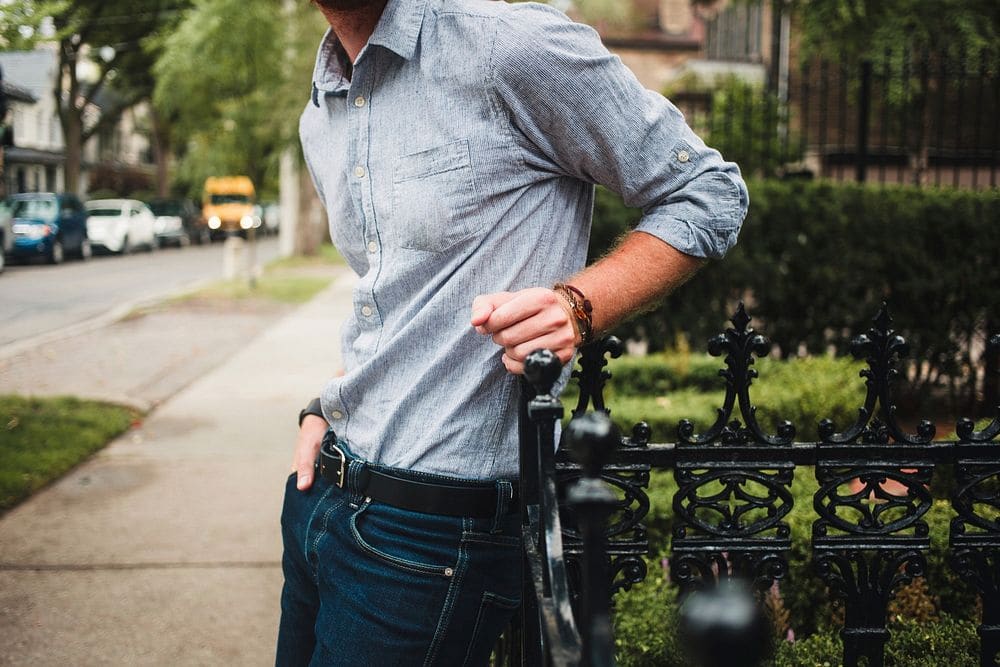
The oxford cloth button-down is the best shirt a man can own, and I have three years of spreadsheet data to back that up. I log what I wear every morning. Outside of T-shirts, the OCBD is my most-worn top by a margin that would be embarrassing if it weren’t so practical. It beats every sweater, every flannel, and every polo I own.
It wins because the cloth and the collar sit right between dressy and casual. The basketweave oxford fabric is textured enough for jeans and boots, and the soft, rolled collar is neat enough for a sport coat or even a tie, so one shirt covers more situations than anything else in your closet. Buy one with an unlined collar, points around 3.25 to 3.5 inches, in standard or heavy cloth, for $90 to $150.
Last Tuesday I wore a blue one to a client lunch, took my kid to a birthday party at a trampoline park, and finished at a friend’s fortieth at a bar with cloth napkins. Untucked for the trampolines, tucked for everything else. Nobody blinked.
It works because it refuses to commit
Most shirts lean one way. A crisp poplin dress shirt wants a tie and leather-soled shoes. A flannel wants boots and a weekend. A polo wants a golf course, or at least the idea of one. The OCBD sits in the middle, and it gets there through a combination of fabric and collar that nothing else quite matches.
Start with the shoes, because that’s where every outfit starts. An oxford shirt looks right over work boots and raw denim. It looks right over chukkas and chinos. It looks right over loafers and gray trousers with a navy sport coat or blazer. It even looks fine, if a bit preppy, with white canvas sneakers and shorts in August. I can’t say that about any other shirt without squinting.
The reason is texture. Oxford cloth is woven in a basketweave, with paired yarns running in at least one direction, and it often mixes a colored yarn with a white one. That gives it a slightly heathered, slightly rough surface that reads casual up close and tidy from across a room. It’s dressy enough to sit under a jacket and rugged enough to wear with something that has rivets on it.
The oxford button-down is the only shirt I own that I never have to think about before I put it on.
The collar is the whole shirt
If you remember one thing from this piece, make it this: buy the collar, not the brand. A good OCBD collar is unlined or very lightly lined, with points long enough to roll softly over the buttons instead of lying flat like a paper tab. That roll is what makes the shirt look relaxed and deliberate at once.
Collar points should run somewhere between 3.25 and 3.5 inches from the seam to the tip. Shorter than about 3 inches and the collar looks stubby and can’t roll; longer than about 3.75 and it starts to look like a costume from an old yearbook. The collar buttons should sit a little back from the points, so the fabric has room to curve before it’s held down. And there shouldn’t be a stiff fused interlining. Squeeze the collar between your fingers in the store. If it feels like cardboard, it’s going to sit like cardboard forever.
A few other construction details matter more than the price tag would suggest. A box pleat or locker loop on the back is nice but optional. Single-needle stitching along the side seams tends to pucker less after washing. A chest pocket is traditional and useful for a pen you’ll lose anyway. A front placket, the strip of fabric where the buttonholes sit, makes the shirt look a touch sportier; a plain front looks slightly dressier. Neither is wrong.
The fabric gets better, then it gets old
The honest arc of an oxford shirt goes like this. When it’s new, the cloth feels a little stiff and slightly coarse. After about 10 to 15 washes it softens noticeably, the collar starts to roll on its own, and the color mellows a shade. That’s the sweet spot, and it lasts. Eventually, somewhere past a few hundred wears, the collar edge and cuffs start to fray. Some people love a frayed collar. I like it for weekends and nowhere else.
Oxford cloth comes in a few weights, and the differences show up in daily wear. A lot of shirts now use a lighter oxford that feels smoother from day one but wears out faster and wrinkles in sad little ways. A heavier, traditional oxford takes longer to break in but holds up much better.
| Fabric | Feel when new | Washes to soften | Typical lifespan |
|---|---|---|---|
| Lightweight oxford | Smooth, thin | 3–5 | 100–150 wears |
| Standard oxford | Slightly coarse | 10–15 | 150–250 wears |
| Heavy oxford | Stiff, textured | 15–25 | 250–350 wears |
| Pinpoint oxford | Smooth, dressy | 2–4 | 150–200 wears |
Pinpoint oxford is a finer, smoother weave that sits closer to a dress shirt. It’s nice under a suit, but it loses the texture that lets an OCBD go anywhere. If you’re buying one oxford shirt, skip the pinpoint and get standard or heavy cloth. I made the pinpoint mistake with my first one and spent two years wondering why it looked so stiff with jeans.
Fit is about the shoulders and the hem
Most people buy a shirt by neck size and sleeve length, which matters for dress shirts and barely matters for a casual oxford you’ll wear open at the collar. What matters more here are the shoulder seam and the hem.
The shoulder seam should sit right at the edge of your shoulder bone, not drooping down your arm and not riding up onto your trapezius. A dropped shoulder makes the shirt look borrowed. A pinched one restricts your arms and pulls the fabric across your back.
The body should leave you room to move without billowing. Pinch the fabric at your sides with the shirt buttoned; a couple of inches on each side is about right for a casual oxford. Less than that and the buttons pull when you sit. More and it balloons when you tuck.
The hem decides whether you can wear it untucked, which I do about half the time. A shirt designed to be tucked has long tails that hang well past your back pocket, and untucked that looks like a nightshirt. If you want one shirt that works both ways, look for a hem that ends around the middle of your back pocket, or about 29 to 30 inches long measured from the base of the collar on a man around 5’10”. Adjust for your height, and trust the mirror over the chart.
Sleeve length matters less than you’d think. I roll mine more often than not, and a good OCBD rolls easily, two turns to just below the elbow. If the sleeves run a little long, a tailor can shorten them for around $20 to $30, but it’s rarely worth it on a casual shirt.
It layers under almost everything you own
The other reason the OCBD keeps topping my spreadsheet is that it never fights whatever goes over it. That soft collar does the work again. Under a crewneck sweater, the points sit neatly on top of the ribbing instead of getting crushed flat, which is why it’s my base layer for layering through a fall day. Under a navy jacket, the roll fills the lapel opening the way a stiff dress collar can’t, so you look put together without looking like you came from a deposition. Under a canvas chore coat, it reads like a shirt you chose rather than a shirt you forgot to change out of.
It also takes a tie, which most casual shirts can’t. A knit or wool tie with an oxford is one of the easiest ways to look dressed for a wedding or a funeral without owning a suit you’ll wear twice a decade, as long as you get tie width and knot size in proportion to that soft collar. I’ve done both. Nobody asked where the rest of my suit was.
The one place it falls short is real heat. On a 95°F afternoon, standard oxford cloth is heavier than you want, and linen or seersucker is the better call. That’s a real trade-off, and I accept it. For roughly nine months a year this shirt is the most dependable thing in my closet, and in the other three I still reach for it after sundown. It’s also the easiest answer I know to business casual without khakis, since it reads as a decision even with dark jeans.
Buy your oxford cloth button-downs in this order
If I were starting over, I’d build up oxford shirts like this. Start with light blue. It goes with every trouser in your closet and flatters almost every complexion. Second, get white, which looks a little sharper and works especially well under a navy jacket. After that, if you love the shirt, consider a blue university stripe, a pale pink, or a pale yellow. I’d stop at four or five.
| Order | Color | Best with |
|---|---|---|
| 1 | Light blue | Jeans, chinos, gray trousers |
| 2 | White | Navy jacket, dark denim |
| 3 | Blue university stripe | Chinos, khaki shorts |
| 4 | Pink or yellow | Navy chinos, summer weekends |
On price: a solid oxford cloth button-down in good cloth with a proper collar costs about $90 to $150. You can find them for $40 or less, and those tend to use lightweight cloth with a fused collar that will never roll the way you want. You can also pay $250 or more, and there you’re mostly paying for a label rather than better construction. The middle of the range is where the value lives.
Do the math on a $120 shirt worn once a week for three years. That’s around 150 wears, or roughly 80 cents a wear. A $40 shirt that pills and loses its collar shape inside a year, and gets worn maybe 40 times before you give up on it, costs about $1 a wear and looks worse the whole time. If your closet is mostly T-shirts right now, an oxford is the natural next step up from a good heavyweight white tee, and it costs about what three of them do.
Care is easy, which is part of the appeal. Wash in cold or warm water, tumble dry low or hang to dry, and if you want it sharper, iron it while it’s still damp. Skip the starch. I iron mine maybe a third of the time, mostly the collar and placket, and let the rest stay rumpled, which is how the shirt looks best anyway.
Store them on a decent hanger with shaped shoulders rather than wire, which leaves dimples in the shoulders. They also fold fine if you’re short on closet space; just leave the collar unbuttoned in the drawer so the points don’t take a crease in the wrong place. More on the rest of a practical casual closet lives in our everyday guides.
The verdict: Buy a light blue oxford cloth button-down in standard or heavy cloth, with unlined collar points around 3.25 to 3.5 inches and a hem that ends mid back pocket, for somewhere between $90 and $150. Wear it with everything from boots to loafers for a year, then add a white one, and stop there until one of them wears out.
Next stops
All Everyday guides
Layering for Fall When the Day Swings 30 Degrees
A 41-degree morning and a 71-degree afternoon need three light layers you can shed in order, starting with a boot that handles both.
Danny Reyes 6 min
Buying White T-Shirts: Fabric Weight Over Brand
The number that decides whether a white tee lasts a year or goes see-through by June is printed in ounces, and most people never look for it.
Danny Reyes 4 min

Tie Width, Knots, and Proportion
Match the tie to your lapel within a quarter inch, scale the knot to your collar, and stop at the buckle. A ruler settles most of it.
Theo Lindqvist 5 min