Stop 04 · Accessories Fit Notes
Sunglasses That Fit: Bridge, Lens Width, and Temple Length
Three small numbers printed inside the arm tell you more about how a pair will sit on your face than any face-shape chart. Here's how to read them and what to measure.
By Theo Lindqvist, Accessories Editor
· 9 min read · 1,930 words
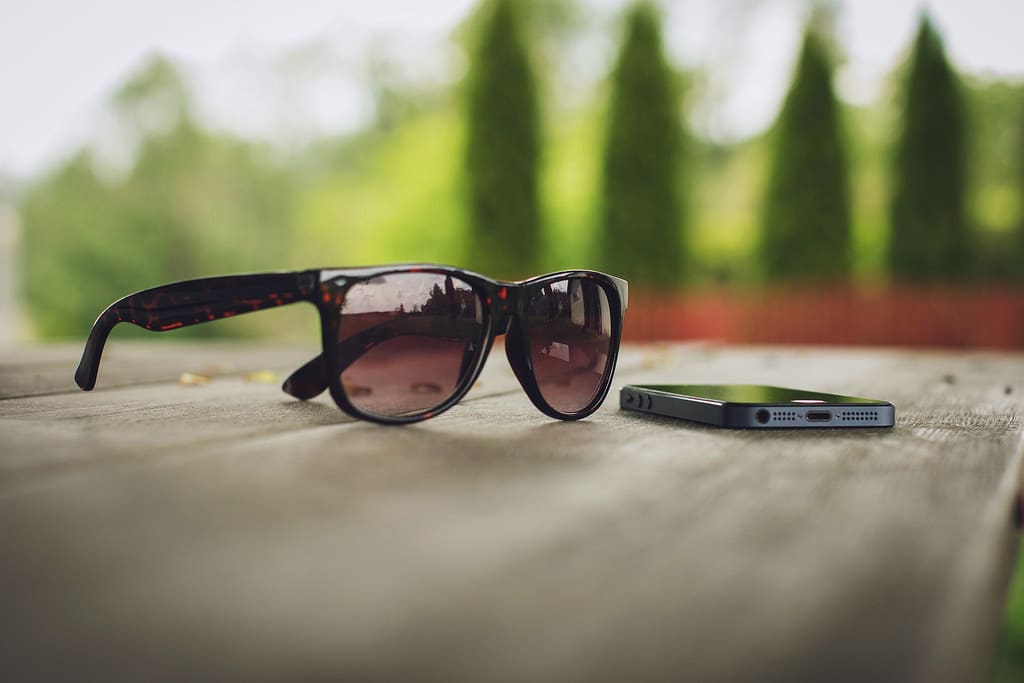
Look at the inside of the left arm on any decent pair of sunglasses and you’ll find something like 52□18-145. Most people never notice it. That string is the whole fit of the frame, and it’s more useful than every face-shape chart ever drawn.
I’ve owned one pair of sunglasses for six years and tried on perhaps two hundred before buying it. Most of those failed for boring, measurable reasons: they pinched behind the ears, slid down my nose at the first sign of sweat, or sat so wide that my eyes looked like they’d wandered toward the middle of the lenses. None of that was about whether my face is “oval” or “square.”
Short answer first. Sunglasses size comes down to three numbers: lens width (the first, usually 48 to 58 mm), bridge width (the second, usually 14 to 24 mm), and temple length (the third, usually 135 to 150 mm). Get the total frame width close to the width of your face, get the bridge to sit on your nose without gaps or pinching, and get the arms long enough to bend just behind your ears. Shape is a matter of taste after that.
The three numbers on the arm
Frame sizes are printed in millimeters everywhere in the world, including here. You’ll need to think in them for a few minutes. Inches where they help.
Lens width is the horizontal width of one lens at its widest point. A 52 means 52 mm, a little over 2 inches. This number does most of the work in deciding how big the frame looks on you.
Bridge width is the gap between the two lenses, measured where the frame crosses your nose. An 18 is 18 mm, roughly the width of a dime. Small numbers fit narrow, high noses; larger ones fit broader, flatter bridges.
Temple length is the length of the arm from the hinge to the tip, including the bend. A 145 is 145 mm, about 5.7 inches.
The little square between the first two numbers just tells you the measurements follow the boxing system, which is the industry standard. Some brands print a dash instead. It means the same thing.
Here’s how those numbers typically translate into fit.
| Measurement | Narrow face | Medium face | Wide face |
|---|---|---|---|
| Lens width | 46–50 mm | 51–54 mm | 55–60 mm |
| Bridge width | 14–17 mm | 17–20 mm | 20–24 mm |
| Temple length | 135–140 mm | 140–145 mm | 145–150 mm |
| Face width, temple to temple | Under 5.1 in | 5.1–5.5 in | Over 5.5 in |
The ranges overlap. Treat them as a starting point.
Measure your face once, in two minutes
You need a ruler or a tape measure and a mirror. A pair that already fits is even better.
If you own a pair that fits, look inside the arm and write down the numbers. That’s your baseline. Any frame within about 2 mm on lens width and bridge, and 5 mm on temple length, is likely to feel close.
If you don’t, measure your face width. Stand in front of a mirror and hold a ruler horizontally just under your eyes. Measure from the outer edge of one temple to the other, roughly where the arms of a frame would pass. Most men land between 5 and 6 inches. Convert to millimeters by multiplying by 25.4.
The total front width of a frame is roughly two lens widths plus the bridge, plus a few millimeters for the frame edges. A 52□18 frame comes out around 130 to 135 mm, or about 5.2 inches. If that number is within a quarter inch of your face width, you’re in the right territory.
Temple length is harder to measure on yourself. Run a soft tape from the outer corner of your eye straight back to the top of your ear, then down a little behind it. If that’s around 5.5 inches, look at 140 mm arms. If you wear a hat often, or your ears sit far back, go longer.
If the frame is wider than your face, everything else about the fit will be a compromise.
The bridge decides whether they stay put
Lens width gets the attention because you can see it in the mirror. The bridge is the measurement that actually keeps a pair on your face.
A bridge that’s too narrow sits high and pinches, leaving red marks on either side of your nose by lunch. A bridge that’s too wide lets the frame drop until the lenses rest on your cheeks, and every time you smile the whole thing lifts. In summer heat, a wide bridge plus a little sweat means you’re pushing them up every two minutes.
What to check: the frame should touch your nose evenly along both sides, with no gap at the top and no single pressure point. Your eyes should sit roughly in the vertical center of each lens, or slightly above it.
Acetate frames with a fixed bridge are less forgiving. They fit a certain nose or they don’t. Metal frames with adjustable nose pads give you more room, because the pads can be bent in or out a millimeter or two. If you have a low nose bridge, which is common, look for frames labeled “low bridge fit” or “Asian fit.” The name is clumsy, but the cut is useful: the nose pads sit higher and further forward, so the lenses clear your cheeks and lashes.
I learned this the expensive way. My first good pair had a lovely heavy acetate front and a bridge 2 mm too wide. They looked right in the shop for the thirty seconds I stood still. Walking down the street, they slid every time I looked down at my phone. I gave them away within a year.
Temples and weight: the part you feel at hour three
Short temples pull the frame back against your nose and press behind the ears. Long temples let the frame slide forward and down. The bend should start right where the top of your ear meets your head, and the tip should follow the curve behind the ear without digging in.
Most optical shops will adjust temple tips on sunglasses for free, even if you didn’t buy them there. Metal temples bend easily. Acetate temples soften with gentle heat, which a shop does with a frame warmer, never a hair dryer at home.
Weight is the other thing you only notice later. A light metal frame might weigh 15 to 20 grams. A chunky acetate pair can reach 35 grams or more, and that’s sitting on two small points on your nose all afternoon.
| Frame type | Typical weight | Adjustable fit | Notes |
|---|---|---|---|
| Thin metal, nose pads | 15–22 g | High | Easiest to fit |
| Light acetate | 22–28 g | Medium | Fixed bridge |
| Heavy acetate | 30–40 g | Low | Slides when warm |
| Nylon or injected sport | 20–28 g | Low | Light, less refined |
My rule: under 30 grams, about one ounce, for a pair I’ll wear all day. Anything heavier needs a perfect bridge or it’ll ride down your nose by midafternoon. I pay the same attention to grams on a watch, for the same reason, which I go into in the guide to watch straps for real life.
Proportion matters more than face shape
Face-shape advice tells you round faces need angular frames and square faces need round ones. It isn’t wrong, exactly. It’s just secondary. A round frame in the right size beats a “correct” shape in the wrong size every time.
Proportion is what people actually register:
- The top edge of the frame should sit near your eyebrows, roughly following them. Frames that sit far below the brow look small; frames well above it look like goggles.
- Your eyes should land near the horizontal center of each lens. If they drift toward the inner edges, the frame is too wide.
- The outer edges of the frame should line up with, or sit just past, the widest point of your face.
Scale also matters relative to everything else you wear. A big head and broad shoulders can carry a bigger frame, the same way they can carry a wider tie. A slight build with small features looks swamped by oversize lenses. I make the same argument about tie width and proportion, and it holds here.
Lenses, try-ons, and what the money buys
Fit first, but don’t skip the lens basics.
UV protection. Look for “UV400” or “100% UVA/UVB.” Dark tint alone means nothing; a cheap dark lens without UV filtering lets your pupils open wider and lets more UV in.
Polarization. Polarized lenses cut glare from water, wet roads, and car hoods. They’re excellent for driving and for summer near water. The catch: they can make phone screens and some car dashboards look dark or patchy at certain angles.
Lens category. Most general-purpose sunglasses are category 3, which blocks around 82 to 92 percent of visible light. Category 4 is for glaciers and high-altitude snow and isn’t legal for driving in some places.
Lens color. Gray keeps colors true. Brown and amber add contrast and warmth, which is nice on bright, flat days. Green sits between them.
If your summer plans involve long, bright days, the pair you buy matters as much as the shirt you wear, and I’d pair this guide with our notes on dressing for 90-degree heat. For travel, a hard case is non-negotiable. A soft pouch in a carry-on bag means scratched lenses within a week, a lesson that fits neatly into packing a week in a carry-on.
How to try on a pair in a store
Bring a pair that already fits if you have one, and compare the numbers on the arm. Then:
- Look straight ahead in the mirror. Check eyebrow line and eye position.
- Smile broadly. If the frame lifts off your nose, the lenses are touching your cheeks.
- Look down at the floor for ten seconds. If the frame slides, the bridge is too wide or the temples are too short.
- Shake your head gently side to side. A good fit stays put.
- Wear them for five minutes. Pressure behind the ears or at the nose shows up by then.
Online, buy only where returns are free, and order by the numbers on the arm of your best-fitting pair, not by a photo on a model.
Where the money goes
A pair of sunglasses at $25 and a pair at $250 can block exactly the same UV. The extra money buys lens clarity, better hinges, frames that can be adjusted and repaired, and materials that hold their shape. You’ll notice the hinges and the adjustability after a year. You’ll notice clear lenses after an hour of driving.
My own pair cost a bit under $200, metal, 52□19-145, 19 grams. It’s been bent back into shape twice by an optician at no charge and had one set of nose pads replaced for a few dollars. That’s the version of buying better that I believe in.
The verdict: Ignore face-shape charts until you’ve got the numbers right. Find the three sizes printed inside a pair that already fits you, or measure your face width and aim for a frame front within a quarter inch of it, a bridge that sits evenly on your nose, and temples that bend just behind your ears. Keep all-day frames under about 30 grams, insist on UV400, and choose polarized lenses if you drive or spend time near water. For more on getting proportion right in the small things, browse our accessories guides, or start with the case for a thinner wallet.
Next stops
All Accessories guides
Watch Straps: Leather, Nylon, and Steel for Real Life
One watch can wear several straps, but most men need two at most. Choose them for your wrist and the weather they'll see, not for the dial.
Theo Lindqvist 5 min
The Case for a Thinner Wallet
Most wallets are thick because of what's in them, not how they're made. Carry six cards in half an inch of leather and put the rest somewhere else.
Theo Lindqvist 6 min

The Shoulder Is the One Fit You Can't Fix
Sleeves, waists, and hems are a tailor's daily bread, but a shoulder that is wrong in the store will be wrong for the life of the jacket.
Julian Okafor 8 min